Leslie de Bont receiving her award. copyright Chancellerie des universités
The May Sinclair Society would like to offer happy and hearty congratulations to Leslie de Bont, who has received the “Prix de thèse André Topia (études modernistes)” for her PhD thesis on May Sinclair: ‘Like anecdotes from a case-book: Dialogues entre discours théoriques et cas particuliers dans les romans de May Sinclair. The André Topia prize is part of a prestigious series of prizes called “Les Prix de la Chancellerie des Universités de Paris”. La Chancellerie des Universités is a 800 years old organisation that oversees all the higher-education institutions in Paris and the suburbs. There are about 60 prizes, and they are given each year to the best research/PhD thesis defended in Paris. The ceremony took place on the 1st December 2016 in the Grand Amphithéâtre de la Sorbonne, which dates back from 1889. In the photo Leslie is shaking hands with the Head of the University Paris 3 – Sorbonne Nouvelle, the University where she defended her thesis.
Leslie says: ‘Among other things, the prize will help me translate and publish my thesis, and it will definitely bring Sinclair some attention in France’!
My best thanks for W. Van de Weer’s book – wh. interested me very much. A little too much topography, perhaps, for the human drama. It’s essentially a short story & oughtn’t to have been stretched & padded into a novel. Still, it’s clever & I had to finish it.
With kindest regards to you & Mrs. Lane & best wishes for 1918.
sincerely
May Sinclair
The letter belongs to Emily Fennell, who owns a collection of Sinclair first editions. Emily found the letter tucked inside her copy of Sinclair’s book length poem The Dark Night, which she had bought from a second hand seller on abebooks. She said ‘[I] don’t even think I noticed the letter until some time later. I don’t think I would have selected that particular copy because of the letter or signed aspect (nice as they are) but simply because it was the only one available’.
The original listing mentions the letter but doesn’t make any great fanfare about its presence tucked inside the book:
Limited to 150 copies Signed and numbered by the author. With an ALS from Sinclair to London publisher John Lane laid in.
It is unclear how intimately Sinclair knew John Lane. Theophilus Boll places her at a party Lane gave in 1914 to launch Wyndham Lewis’s Blast! (‘May Sinclair enjoyed herself hugely with Ivor Brown at the dinner that John Lane gave on July 15, 1914, at the Dieudonné Restaurant in Ryder Street, St. James, to set off the Blast!’).1 Ivor Brown said of this ‘I don’t know how far M.S. was impressed, but at that period she liked to go about and be in the midst of literary goings-on’.2 If Sinclair and Lane were both integral and enthusiastic participants in the London literary ‘scene’ then it’s possible they saw each other regularly.
Sinclair also wrote an introduction for Lane’s publication of The Closed Door by the illustrator Jean de Bosschère in September 1917 in which she praised the poet and illustrator’s ‘Sharpness, precision, purity, the cold clearness of crystal, hardness attained by concentration, by sheer pressure of spiritual intensity’.3 Bosschère later illustrated Uncanny Stories for its publication in 1923.
The writer Sinclair refers to as ‘W. Van de Weer’ is probably Willem de Veer, whose novels An Emperor in the Dock (1915) and Revoke (1917) had been published by John Lane: The Bodley Head. He also wrote a series of epistolary articles for The New Age titled ‘Holland and the World War.’ Ads for two of his novels (Battle Royal and The Emperor in the Dock) appear respectively in the first and second Blast. It’s unclear which of these novels Sinclair is referring to, but it is likely to be Revoke, published in 1917.
Thanks are due to Joanna Bek and Tyler Babbie for their research expertise and their help in tracing the identity and literary outputs of de Veer!
[edit: 03/11/16. Philippa Martindale suggests that Sinclair adds the ‘Van’ in de Weer’s name because she is mixing up two authors: Willem de Veer and Lenore Van de Veer, who she refers to in two letters, one dated 1 December 1915 and one dated 8 June 1918. Thanks are also due to Philippa for her help with the transcription of the letter].
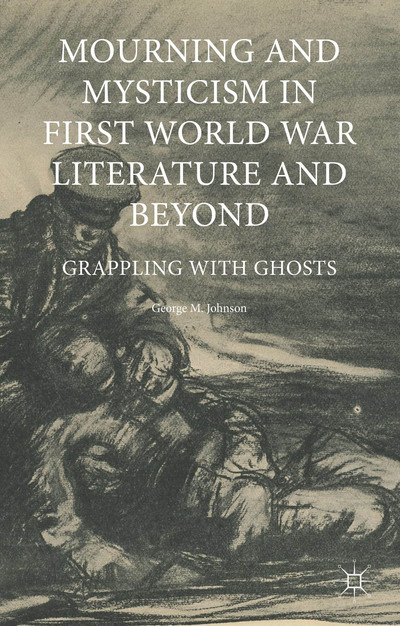
This new book by George M. Johnson, entitled Mourning and Mysticism in the First World War and Beyond, might be of interest to Society members. It contains a chapter on Sinclair, Woolf and mysticism.
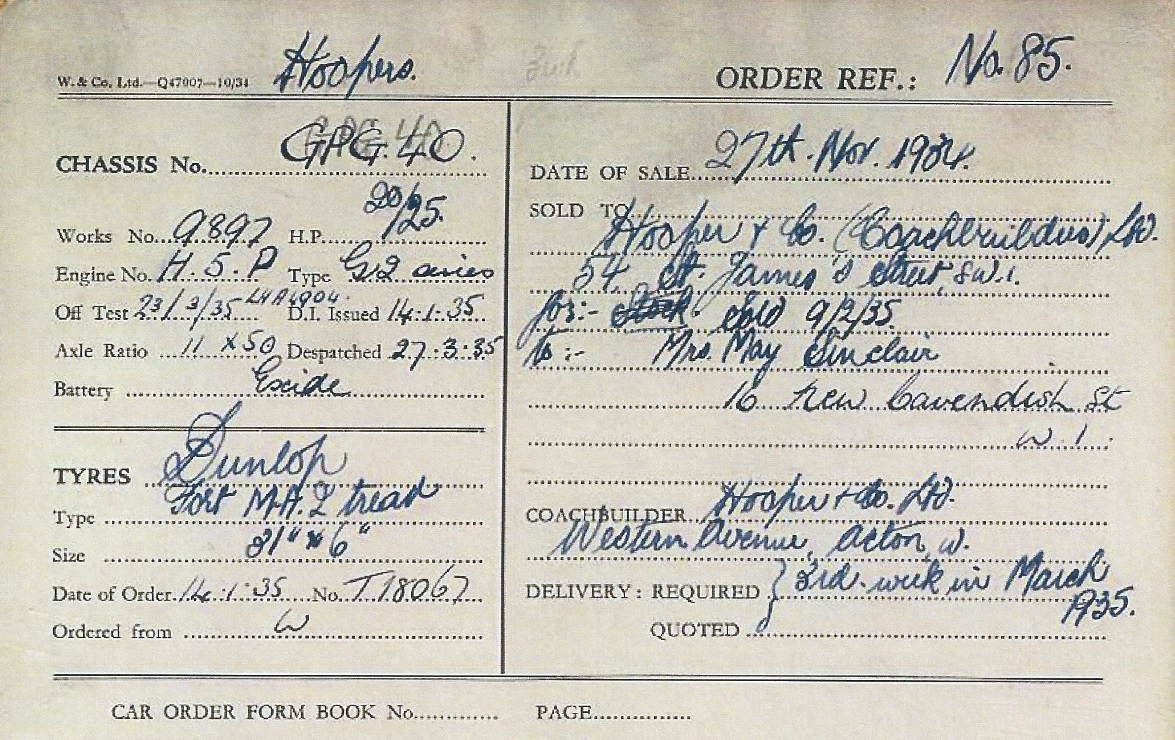
The May Sinclair Society was contacted last year by a Lionel Guilbert, of Florida, who was in the process of renovating a 1930s Rolls Royce, and wondered if the ‘Mrs May Sinclair’, of 16 Cavendish Street London who was named in the Rolls Royce archives as the first owner could possibly be our ‘Miss May Sinclair, novelist’.
The order receipt, with the name of the first owner: ‘Mrs’ May Sinclair.
Was this May Sinclair’s car?
In 1934, Sinclair was living at Pembroke Cottage, Little Tingewick, in Buckinghamshire, with her maid and companion, Florence Bartrop. She moved to the Gables, 96, Burcott Lane, Bierton in 1936, where she died in 1946. She first acquired a car in 1919 and continued to own one until her death in 1946. May Sinclair loved being driven around by her chauffeur, Ernest Williams, and she, Florence and Ernest took at least three extended trips in the 1930s, one around Wales, one around Yorkshire, and one to the Isle of Wight. May Sinclair’s particular pleasure was to be driven very fast, because, according to her doctor, the shaking of a speeding car made her less aware of the tremor caused by her Parkinson’s disease. She also liked the feeling that she owned the road: her first biographer, Theophilus M. Boll, recounts how she would beg Ernest to overtake any vehicles they saw in front of them.
We have so little information about Sinclair’s life after her retreat from the literary spotlight that it is impossible to say for sure, but it does seem likely that this Rolls Royce did indeed belong to her.
Lionel says:
“Tom lived in Rochester, NY when he bought the car in 1974 after seeing it, driving by a gas station on his way to get ice cream. It was for sale in Montauk, Long Island, NY. He contacted the owner, a NY doctor, and flew back to Long Island to pick-up the car and drive it back to Rochester, at night, in the rain. He told me that was a challenge, as the wipers on older cars are not the most efficient ones . . .
This was the first car to his current collection of about 25 cars, including 2 other Rolls, one Bentley, three Ferraris, Aston Martin, Jaguar, Corvettes and others. He showed the car at various shows in the NE but never had the time to restore it fully, only giving it a new paint. It was in a pretty rough shape, its original folding leather roof having been replaced with a permanent plywood roof, and its interior leather and carpet in poor condition. One thing Tom keeps mentioning however is how reliable the engine has always been, and to this day, it starts on the first crank.
As Tom moved to Florida in the late 1980s, he left the car in upstate NY inside a friend’s barn, The car stayed there for over 20 years, where moths and mice proceeded to eat away at the wool carpet and horse hair used in the seat cushions. We moved the car to FL in 2001 and kept it in a climate controlled garage since then. We started the restoration last March, in prevision for the US’ Rolls Royce Owner’s Club annual meet that takes place in Orlando, FL nest week. The car is ready. We worked on the engine and chassis mechanicals first, then began the cleaning process to remove 80 years of accumulated dirt and grease. We removed the fake roof and commissioned a wood worker to re-create the rotted wood frame for the original roof line, and refinish the delicate interior wood dash and door trims. Some interior items like turn signal system, side windows cranking mechanism, seat tracks, tool trays, floor boards and trunk compartment were worked on prior to taking the car to the upholstery shop where it remained 4 months. I redid some parts of the paint on the body, repainted the complete undercarriage, engine and engine accessories, polished the aluminum and chrome parts, installed new tires and exhaust system, and re-created the folding front roof support frame and hinges, and a myriad of other small details.
The doctor in NY owned the car for several years prior to Tom. Over the years people told him they remembered seen this Rolls in NY City many times. The doctor used to tow his small boat on Long Island with the car as well. The doctor bought the car from Scotland, where it is believed the roof got replaced, and one more owner had custody of the Rolls between the doctor and May Sinclair. Factory and Rolls Royce historical records show that May bought the car new in 1934 and kept it until 1938. The whereabouts of the car during WWII are unknown, until the doctor brought it from Scotland to the US. The car is in good hands now and in good company”.
Here are some more photos of the car, newly restored and looking rather lovely:
We are delighted to announce the programme for the May Sinclair Society Symposium. We had an overwhelming response to our call for papers, and the resultant programme reflects, we think, the wealth and breadth of current Sinclair research. We hope you will join us for what looks set to be an exciting and interesting day!
The symposium is a free event, but we ask that all delegates register their attendance by the 27th of June, so we can confirm catering numbers.
The day after the conference (Saturday 19th July) there will be a conference trip to Swaledale Museum, and a guided walk around Swaledale with curator Helen Clifford. The walk will take in Sinclair’s home, the houses on which she based Mary Olivier’s and Dr Rowcliffe’s homes, and some of her habitual walks – all with passages from the books to hand. There will be a nominal cost to this trip, which will include minibus hire, refreshments, and a donation towards the cost of the guided walk. This will be confirmed once numbers are known, but is not expected to be more than £20.
If you would like to join us on the walk, please indicate this on your registration form.
The symposium will be held at Sheffield Hallam University, The Cantor Building, Room 9020a. For campus maps and further information about Sheffield Hallam’s campus, see the visitors’ guide.
The newly-launched May Sinclair Society is to hold its Introductory Symposium on Friday, 18 July 2014. The symposium is organised by the May Sinclair Society: https://maysinclairsociety.com/ with the support of the Humanities Research Centre, Sheffield Hallam University. A keynote talk will be given by Professor Suzanne Raitt of the College of William and Mary, Virginia.
Papers are invited on any aspect of Sinclair’s life and work. Although this will primarily be an academic event, contributions from associates or enthusiasts of Sinclair would be particularly welcome. Please forward 300-word abstracts in a Word document format to maysinclairsociety@sheffield.ac.uk by 31 March 2014.
Admission to the event will be free and lunch and refreshments will be provided. There will also be an optional visit to the Swaledale Museum on Saturday 19 July, which includes a guided walk taking in Sinclair’s house and some of the buildings which inspired her settings for Mary Olivier and The Three Sisters. Details will be forwarded along with registration documents.





 maysinclairsociety.com