May Sinclair Papers at the University of Sussex

The papers at The Keep, University of Sussex were unsorted and impossible to use in any meaningful sense. They have now been sorted, catalogued, and are available for researchers.

You can view the catalogue here – https://www.thekeep.info/collections/getrecord/GB181_SxMs172

Sinclair left behind her a huge amount of manuscript material relating to her creative and non-fiction writings, and her archives at the Kislak Center, University of Pennsylvania, have been catalogued and accessible for sixty years. Until recently it was assumed these were her only surviving manuscripts, but in 2013, a distant family member donated a trunk full of papers to the University of Sussex.

The papers in the trunk looked as though they had been scattered about and then hastily pulled back together, with a few pages from one manuscript and then a few from another, all out of order. Archival practice is usually to present an archive in its original form, but we quickly realised that this was not helpful in this case.
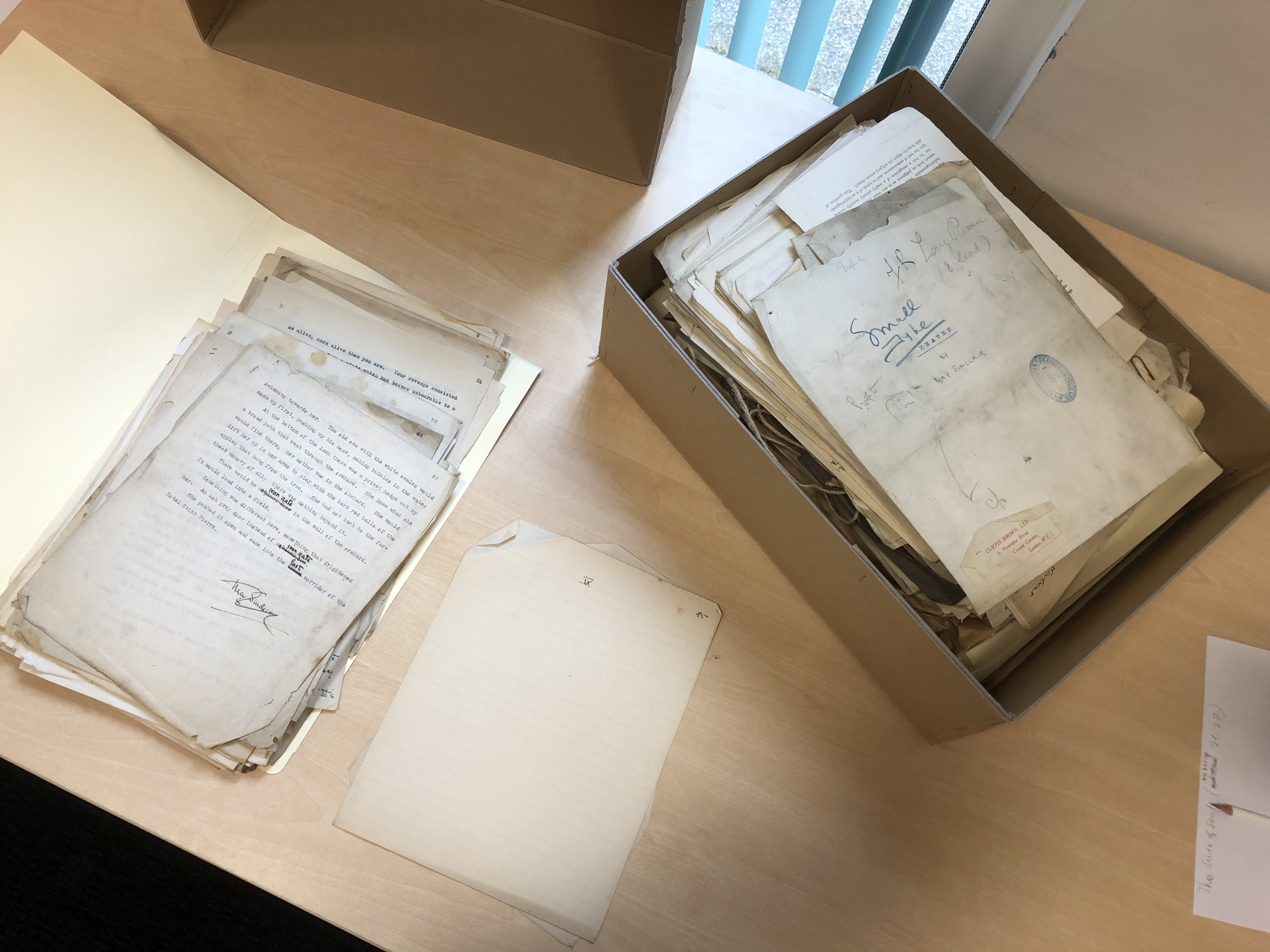
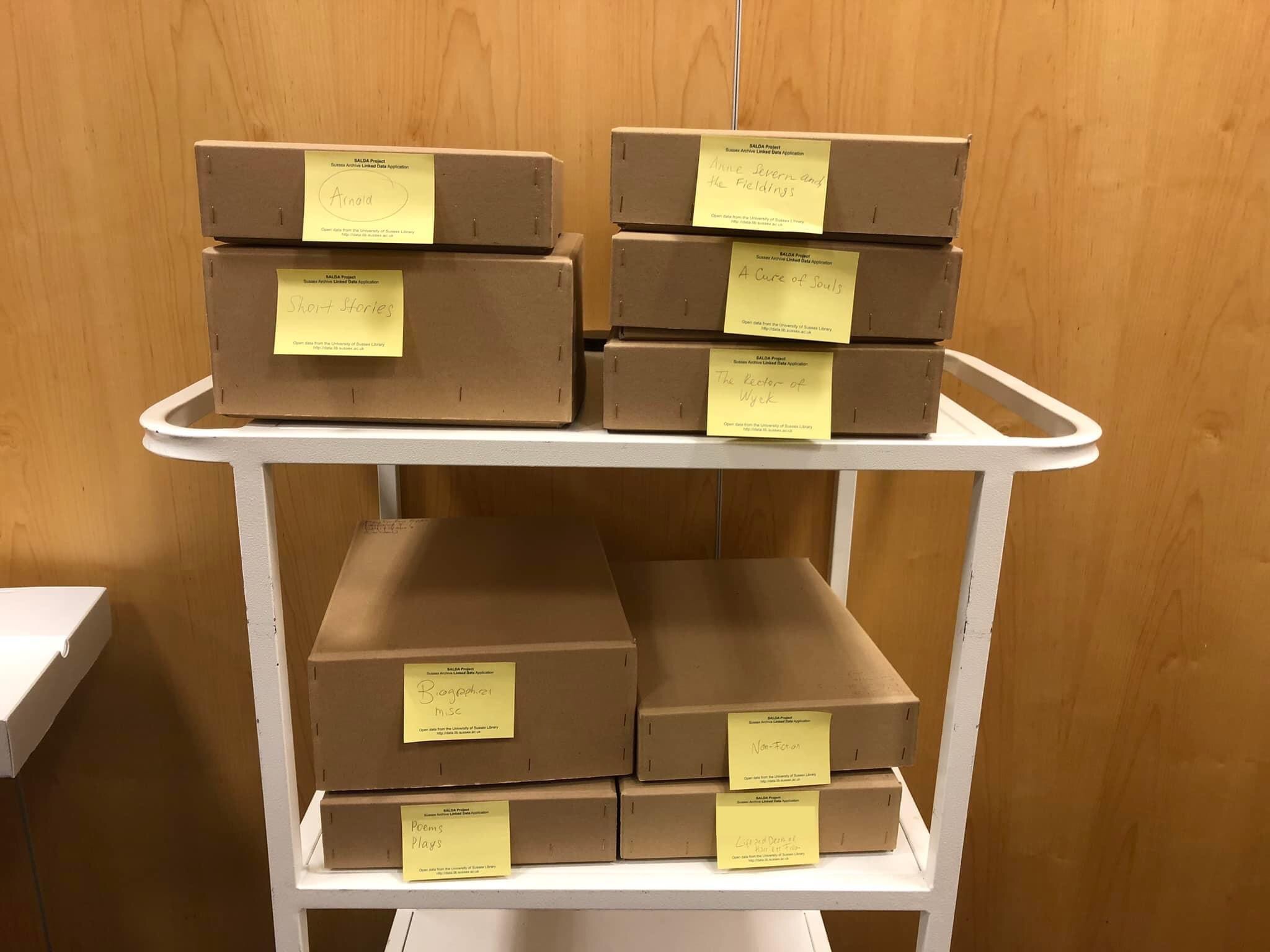
In May and June, 2024, the Sinclair project team – Rebecca Bowler, Claire Drewery, Olha Honcharova and Karen Watson – spent three weeks in the archives, sorting and then cataloguing the papers. This involved spreading out over multiple tables, reuniting odd pages of manuscripts, and establishing what was there. We discovered that there are some complete manuscripts – Anne Severn and the Fieldings (1922), Life and Death of Harriett Frean (1922), Arnold Waterlow: A Life (1924), A Cure of Souls (1924) and The Rector of Wyck (1925) – and some partial manuscripts. There are many drafts of the short stories, some plays and poetry, and a wealth of biographical and financial material. Of the partial manuscripts it is sometimes clear that whereas The Kislak Center at the University of Pennsylvania holds part of one document, The Keep, University of Sussex, holds the rest of it. The manuscripts at Penn and at Sussex were one collection and at some point in the past became separated.

We’ve included in the catalogue some indicative descriptions of some of the more interesting holdings, including the state of the manuscripts, original material, how it corresponds with the archive at the University of Pennsylvania, and the extent of Sinclair’s revisions. We hope that this will help researchers who want to examine the papers to plan their visit!
The team are grateful to the British Academy for funding this work.
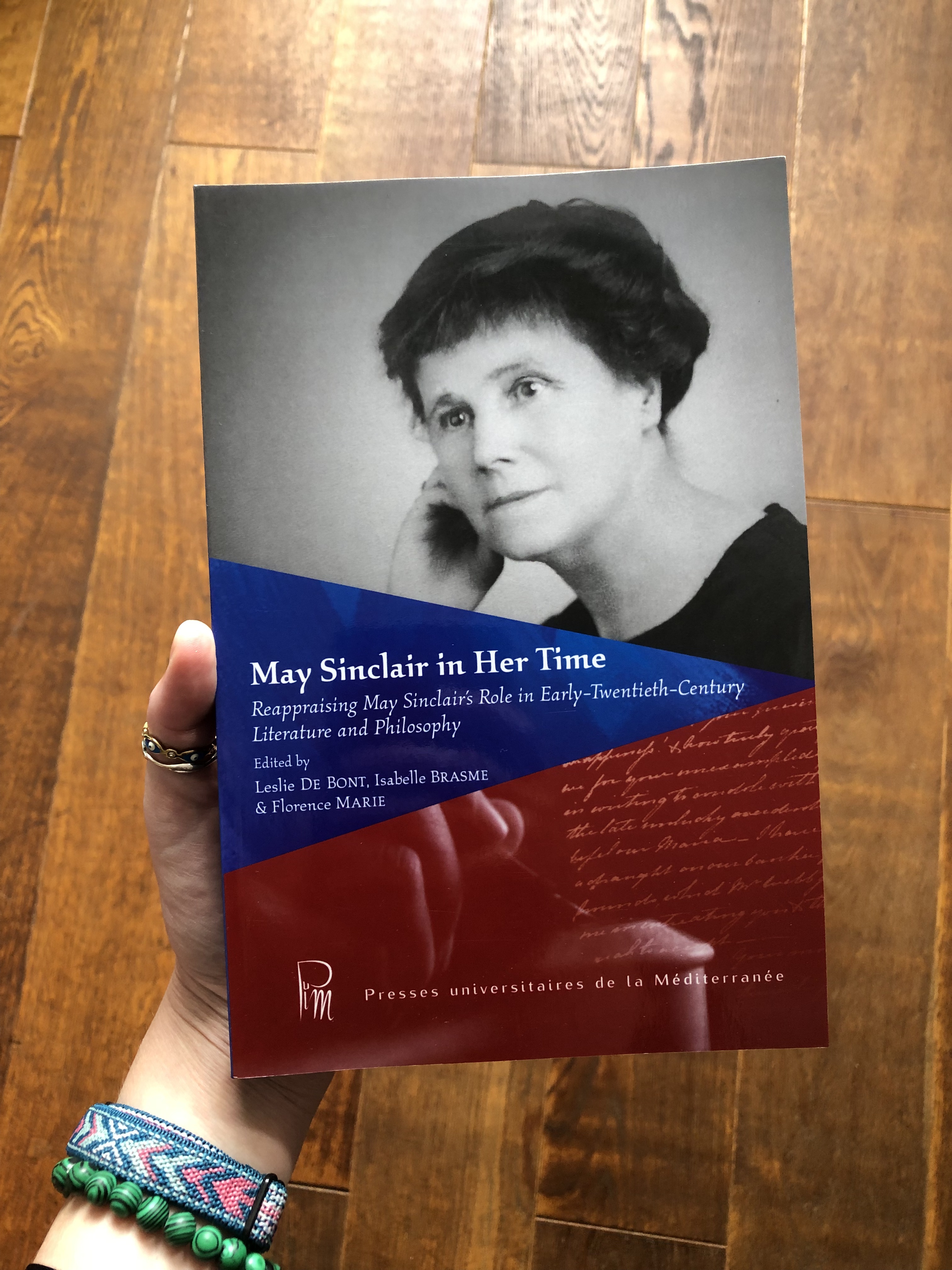
May Sinclair in Her Time

New work on May Sinclair, edited by Leslie de Bont, Isabelle Brasme and Florence Marie, published by the Presses universitaires de la Méditerranée.

The edited collection was inspired by research presented at the NETWORKING MAY SINCLAIR conference, held at the UNIVERSITÉ DE NANTES on the 24-25 June 2021.


Contents:

Philippa Martindale, ‘Swimming on the Top of This Wave’: May Sinclair’s Letters and the Development of a Modernist Aesthetic.

Sanna Melin Schyllert, May Sinclair’s Public Persona and Fictional Characterisations in H.D.’s Asphodel (1992) and Bid Me to Live (1960).

Suzana Zink. ‘Miss Sinclair’s Sparkles’: May Sinclair in Contemporary Newspapers.

Christine Battersby, The Obscured Childhood Home: May Sinclair, Samuel Butler and the Problem of Heredity.

Maria Juko, Victorian Ideas of Women’s Independence and May Sinclair’s The Three Sisters.

James Thrall, Tapping the Power: Uncanny Communication and Sublimated Will in May Sinclair.

Claire Drewery, A Sudden Corporeal Manifestation: the ‘Sublimative Epiphany’ as Material Aesthetic in the Modernist Novels of May Sinclair and James Joyce.

Rebecca Bowler, May Sinclair’s Dialogic Tesserae.

Leslie de Bont, ‘No Other House Will Ever Be to You What I Have Been’: Atopic Domesticity, Social Affects and Place-Identity in May Sinclair.

Milena Schwab-Graham, ‘Sharp, Queer, Uncertain Happiness’: Walking as Feminist ‘Affective Militancy’ in May Sinclair’s Mary Olivier (1919) and The Three Sisters (1914).

Shalini Sengupta, Broken Gifts: ay Sinclair, Modernism, and the Motif of Exchange.

https://www.pulm.fr/index.php/default/may-sinclair-in-her-time.html

Networking May Sinclair – presentations online

The Networking May Sinclair conference, held at the Université de Nantes in June 2020, was a productive and stimulating event, with so many thought-provoking and entertaining papers. The Sinclair Society would like to thank the organisers wholeheartedly for all their work putting the programme together and embracing the digital challenge.

If you didn’t make it to the conference, but were interested in hearing some of the papers (or indeed if you did make it but you’d like to hear some of the papers again) you’ll be interested to know that recorded versions have been made available by the Université de Nantes. Take a look! https://mediaserver.univ-nantes.fr/channels/#crini

Networking May Sinclair: Online Conference

The programme for ‘Networking May Sinclair’ is now confirmed! This two-day event, originally planned in-person in 2020, will now be held on Zoom on the 24th and 25th of June, 2021. Registration is free, and you can reserve your place by emailing Florence Marie at florence.marie@univ-pau.fr – all welcome.

Please note all times are Paris time (UTC/GMT +2 hours), as this event is hosted at Nantes.

[Programme edited 17/06/21]

NETWORKING MAY SINCLAIR

UNIVERSITÉ DE NANTES, 24-25 June 2021

Convenors : Leslie de Bont, Isabelle Brasme & Florence Marie

Thursday 24 June

10:15 Welcome Address (“Paris time – UTC/GMT +2 hours”)

10:30-12: May Sinclair between the Victorians and the Modernists

Chair: Florence Marie

Georges Letissier – “The Innocence of the Eye”: May Sinclair’s Reversed Case Study of the Brontës.

Maria Juko – Jessie Boucherett’s Smilesian Gentlewomen in May Sinclair’s Three Sisters.

Isabelle Brasme – May Sinclair, Modernist Critic.

Lunch break

14:00-15:00 Memory and Aftermath

Chair: Isabelle Brasme

Andrew Frayn – “Odd how the War changes us”: May Sinclair, domesticity and war

Jana Funke – “Nothing is lost”: May Sinclair, Inherited Memory and Impersonality.

15-minute break

15:15-16:15 Mysticism

Chair: Claire Drewery

Christine Battersby – With Schopenhauer at the Belgian Front: May Sinclair’s War Journal and Related Texts

James Thrall – Agency and the Modern Mysticism of May Sinclair.

Friday 25 June

10:00- 11:00 Woman in/of letters

Chair: Rebecca Bowler

Suzana Zink – “Miss Sinclair’s Sparkles”: May Sinclair in Contemporary Newspapers

Sanna Schyllert – “‘Don’t have anything to do with them,’ she said”: May Sinclair as a fictional character.

15-minute break

11:15-12:45 Aesthetic Networks

Chair: Sanna Schyllert

Emma Liggins – Women writing the uncanny in the 1920s: May Sinclair, Clemence Dane and Elizabeth Bowen.

Shalini Sengupta – Broken Gifts: May Sinclair, Modernism, and the Motif of Exchange.

Khalid Chaouch – May Sinclair and her Illustrators/Co-Authors.

Lunch break

14:00-15:00 Treading New Ground

Chair: Georges Letissier

Milena Schwab-Graham – “Sharp, queer, uncertain happiness”: Walking as feminist “affective militancy” in May Sinclair’s Mary Olivier.

Faye Pickrem – The Anatomy of Agency in May Sinclair

15-minute break

15:15-16:45 KEYNOTE LECTURE – Rebecca Bowler and Claire Drewery

Chair: Leslie de Bont

Christmas Whodunnit: New Sinclair Letter

Who is “Charles R”?

A new letter has come to light from May Sinclair to Wilfrid Meynell in which Sinclair says she says she is “very much afraid that poor Mr. Wells may be shot unless something is done”. The potential shooter she refers to as “Charles R”, or alternatively “Mr. Smith”. But who is Charles R?

The full text of the letter is as follows:

4 Edwardes Sq. Studios. W

Jan: 19: 1911

My dear Mr. Meynell

“Charles R”s latest is a libellous letter addressed to me + threatening Mr. H. G. Wells (whome he knows to be a friend of mine) so insanely + so dangerously that I have been obliged to write to Mr. Bernard Shaw in Mr. Wells’s interests (he being abroad) + tell him about it. I’ve asked him for the name +address of Mr. Wells’s solicitors +, unless he strongly dissuades me from this course (wh. my own solicitor approves), I shall send Mr. Smith’s letter to them to <deal with.>

I heard that he goes about with a revolver, but I didn’t believe it. Now – after his letter – I am very much afraid that poor Mr. Wells may be shot unless something is done.

I am requesting that my name may not not appear in the matter; for I do not want to be included in Charles R’s scheme of vengeance

The letter contained libellous references to Mr. Shaw Bernard Shaw himself – also to Mr. Belfort Bax! But that’s a detail.

I’m off to Cannes (Hotel Californie) on Saturday early.

With kindest regards

  1. sincerely yrs

May Sinclair


May Sinclair will have known Wilfrid Meynell through his wife Alice Meynell, who was in the Women Writers’ Suffrage League at the same time as Sinclair. Wilfrid Meynell and Sinclair also wrote for some of the same journals in the early 1910s.

Mr Ernest Belfort Bax was a socialist and men’s rights activist. Here is a letter exchange from Wilshires Magazine August-November 1902 between Bax and George Bernard Shaw.

But who is the man with the libellous letters and the revolver? If anyone can shed light on this mystery man, please get in touch! maysinclairsociety@sheffield.ac.uk

We are very much indebted to Oliver Hawkins, the great grandson of Wilfrid Meynell, for sending us this fascinating letter.

Grant Success!

Opening up the Archive: May Sinclair Goes Digital

The May Sinclair Critical Editions team are delighted to announce that we have been awarded a National Endowment for the Humanities Collaborative Award for the digital arm of our editions project. This funding will bring together the General Editors on the Edinburgh Editions of the Works of May Sinclair, the Commissioning Editor at Edinburgh University Press, and individual volume editors from the first tranche of editions together with the Digital Humanities team at the University of Pennsylvania, the Director of the Rare Book and Manuscript Library, and several specialists in archival manuscript research and digital archival practice. The Kislak Center for Rare Books and Manuscripts will host a week-long series of workshops in July 2020 and we will collaboratively produce a digital genetic edition of one of May Sinclair’s short stories, and publish this online as an innovative, open access resource. Our aim here is to begin to open up the archive for scholars and interested readers who can’t get to Philadelphia to look at the manuscripts in person.

The May Sinclair Papers include workbooks, manuscript drafts, typescript drafts (sometimes more than one version), and marked up page proofs of more than half of her novels. Most of Sinclair’s published non-fiction also appears in the holdings at the Kislak Center, including not only holograph copies of the published works, but multiple drafts. There are fifty-two boxes of material relating to Sinclair, including forty-eight individual workbooks, in three of the boxes.

The genetic digital edition we will be working towards will include digitized scans of all drafts of one short story, from the original workbook notes (including the whole workbook, so interdisciplinary connections can be traced), through manuscript and typescript draft, to page proof and the first published version of each text. Users of the website will then be able to trace each idea from its initial inception, through to finished publication.

This good news follows on the heels of the announcement in March of the British Academy/Leverhulme Small Grants: the Sinclair team won funds for research assistance for the project, and the process of hiring for this post has now begun.

CFP: Networking May Sinclair / Les réseaux littéraires de May Sinclair | Université de Nantes, 18th-19th June 2020

Keynote speaker: Professor Suzanne Raitt, College of William & Mary

This international conference explores the diversity of connections, inspirations and influences in the work of modernist writer, May Sinclair (1863-1946). It will be held at the University of Nantes (France) on Thursday 18th and Friday 19th June 2020.

In the first two decades of the twentieth century, May Sinclair was one of the most successful and widely known of British women novelists (Wilson, 2001). She produced over twenty novels and six collections of short stories and collaborated with many modernist writers and poets, including Ford Madox Ford, Ezra Pound, T. S. Eliot, H.D. and Richard Aldington. Her life was also exceptionally rich. She took an active part in the women’s suffrage movement and published several pamphlets for women’s rights between 1908 and 1917. In the early 1910s, she got involved in medico-psychological research, and wrote half a dozen psychoanalytical research papers. In 1915, she spent two weeks near the Belgian front with an ambulance unit and her Journal of Impressions in Belgium was one of the first wartime women’s diaries published in Britain (Raitt 2000, 163). She was also the acclaimed author of two major philosophical essays on idealism (1917 and 1922) that led to her election to the Aristotelian Society. Last, she was an influential literary historian and literary critic and wrote several much-quoted articles and prefaces on the stream of consciousness, the Brontë sisters and imagist poetry.

Many reviewers and critics have shown that May Sinclair’s modernism was not so much a derivation of other contemporary aesthetics but was rather a product of her idiosyncratic articulation of her many research interests and experiences. In addition, “the interdisciplinarity of Sinclair’s output […] eludes straightforward categorisation and this has arguably contributed to the traditional critical neglect of her writing” (Bowler &amp; Drewery 2016, 1).

As May Sinclair is now “gaining critical legitimacy” (Raitt 2016, 23), this conference seeks to explore Sinclair’s texts and contexts and aims to shed light on her place in literary history and on her contribution to “the radical modernist challenge to traditional assumptions about what it means to be human” (Bowler & Drewery 2016, 14). Papers comparing Sinclair and other writers are thus particularly welcome; suggested topics might include (but are not limited to):

  • May Sinclair and her contemporaries: Thomas Hardy, Henry James, H. G. Wells, D. H. Lawrence, Ford Madox Ford, Charlotte Mew, H. D., Richard Aldington, T S. Eliot,
    Ezra Pound, Virginia Woolf, Dorothy Richardson, Katherine Mansfield, Elizabeth
    Bowen, Mary Butts, Olive Moore etc.
  • May Sinclair and modernity/the modern/modernism
  • May Sinclair & WW1 writers
  • May Sinclair and Victorian and late nineteenth-century authors: the Brontë sisters,
    George Eliot, George Meredith etc.
  • May Sinclair and romantic poets: Shelley, Byron etc.
  • May Sinclair and philosophy: Henri Bergson, Bertrand Russell, Baruch Spinoza, T. H. Green, Arthur Schopenhauer, Samuel Butler, Francis Herbert Bradley etc.
  • May Sinclair and psychology: William James, Sigmund Freud, C. G. Jung, Pierre Janet, Melanie Klein, Ella Sharpe, Joan Riviere, Alfred Adler, Charles Myers etc.
  • May Sinclair and mysticism: Evelyn Underhill, the Society for Psychical Research, etc.
  • May Sinclair and first-wave feminism
  • Contemporary reception of May Sinclair
  • May Sinclair and her literary legacy
  • May Sinclair in translation
  • May Sinclair and music
  • May Sinclair and films or TV adaptations

Proposals no longer than 350 words, together with a 200-word biography, should be sent to the conference organisers before February 15th, 2020 [edit: the deadline was previously January 15th but has been extended].

Conference organisers:
Leslie de Bont, Université de Nantes        leslie.debont@univ-nantes.fr
Isabelle Brasme, Université de Nîmes      isabellebrasme@gmail.com
Florence Marie, Université de Pau            florence.marie@univ-pau.fr

Stream of Consciousness Centenary Conference 2018

CALL FOR PAPERS

Stream of Consciousness Centenary Conference

Sheffield Hallam University

26th-28th July 2018


April 2018 marks a hundred years since May Sinclair’s now-famed review of Dorothy Richardson’s Pilgrimage appeared in the modernist periodical The Egoist. In the century following its initial publication, the review has attracted broad critical attention for likening Richardson’s prose-style to a ‘stream of consciousness going on and on’. It was the first acknowledged use of a literary term which was to become a defining aesthetic of modernist literary representations of the daily fluxes, nuances, thoughts and perceptions of the inner life.  As a literary term, however, ‘stream of consciousness’ was controversial from its first inception. Richardson herself wrote vehemently against the label as a ‘more than lamentably ill-chosen metaphor’ which was ‘still, in literary criticism, pursuing its foolish way’ (1990: 433). Although Sinclair had also earlier acknowledged that the term was problematic – she wrote in her philosophical work A Defence of Idealism that ‘the unity of consciousness can certainly not be accounted for or explained on the simple theory of consciousness as a stream’ (1917: 80) – Richardson’s observation was to prove as enduring as it was accurate. The label has not only persisted in critical accounts of modernism; it has remained synonymous with modernist literature.

This centenary conference seeks to draw out discussion of the complexities inherent within the term ‘stream of consciousness’, its intersections with psychological and philosophical discourses of the period, its influences on later literature, the cultural and intellectual debates it inspires, and its centrality – justifiably or otherwise – as a defining aesthetic of literary modernism. How meaningful is this phrase as a modernist term of reference? What are the complexities in definition? What distinguishes it from other modes of subjective representation – often used interchangeably with stream of consciousness – such as interior monologue, dramatic monologue or free indirect discourse? How useful is it as a point of interdisciplinary reference? What are its implications within the broadening scope of recent modernist scholarship, and for the continuing critical re-evaluation and expansion of modernism itself?

Keynote Speakers: Professor Scott McCracken (QMUL) and Professor Max Saunders (KCL)

Topics might include, but are not restricted to:

  • The history of the phrase ‘stream of consciousness’ and the different uses to which it has been put
  • Tensions between unity and fragmentation
  • Spatiality and temporality
  • Being and becoming
  • Psychological prose
  • Lived consciousness as ‘reality’
  • Literary Impressionism
  • Literary terms as metaphor-constructions
  • Affective modernism and consciousness
  • Interiority and gender
  • Prelinguistic thought and modernist language
  • The ‘stream of consciousness’ in poetry
  • The psychological novel’s forebears
  • Late modernist style and consciousness
  • Middlebrow engagements with consciousness
  • Transatlantic modernisms and experimental style

Individual papers should be 20 minutes in length. Please send 300-word abstracts to the conference organisers as well as a brief biography of no more than 200 words.

Panel presentations should be forty-five minutes in length. Please send 800-word abstracts together with biographies of 200 words per person.

Hosted by the May Sinclair Society.

Conference organisers:

Dr Claire Drewery, Sheffield Hallam University

Dr Rebecca Bowler, Keele University

at SOCcentenary@gmail.com

Submission deadline: 30 April 2018.

Edinburgh Critical Editions: Tranche 1 in Progress

Work on the #CriticalEditions project is gathering pace, although the result is a bit like decorating a room and finding crumbling, damp plaster under the old wallpaper. All this has to be corrected before new wallpaper can be hung and you finally see the results of your efforts in all their colourful glory! The General Editors have been sourcing all UK1 editions and producing the digital copy texts that will enable us to get started on the real work of editing. Tracking down all the short fiction has been a very slow, tricky and stop-start process, but barring one trip to the British Library Claire has now traced every variant, including one never-published manuscript copied by Becky from the Kislak Centre, UPenn. This should save a lot of work as we move onto Tranche 2, in which the second volume is being edited by Paul March-Russell. Copy-texts are on the way to being completed for ‘Defence’ and ‘New Idealism’, so work can soon begin in earnest on our first, philosophical tranche. In the meantime, any tips on use of MVED software for compiling variants would be very gratefully received! It’s slow, but we are starting to see progress.

The Edinburgh Critical Editions of the Works of May Sinclair: individual volume editors announced.

It’s been a busy summer for the May Sinclair Society and for the General Editors on the critical editions project. Our call for editors for the critical editions had an overwhelming response and we are delighted to announce the line-up of individual volume editors and the shape of the editions project.

The Edinburgh Critical Editions of the Works of May Sinclair will be published in themed tranches: ‘Philosophy and Mysticism’, ‘Psychology and Genius’, ‘Women, War and Feminism’, ‘Social Satire’ and ‘Social Realism’. Within these tranches, non-fiction and fiction appear side by side so that the dialogues between each can be explored. The Sinclair editions will position Sinclair as philosopher, psychologist, and cultural historian as well as novelist. Work on the first tranche is already underway.

Philosophy and Mysticism

Collected Shorter Fiction vol. 1 (1895-1912) ed. by Claire Drewery and Luke Thurston

A Defence of Idealism (1917) ed. by Claire Drewery and Colin Tyler

Mary Olivier: A Life (1919) ed. by Rebecca Bowler and Claire Drewery

The New Idealism (1922) ed. by Rebecca Bowler and James Connelly

Arnold Waterlow: A Life (1924) ed. by Rebecca Bowler

Psychology and Genius

The Divine Fire (1904) ed. by Claire Drewery

The Creators: A Comedy (1910) ed. by Vicki Mahaffey and Wendy Truran

The Three Brontës (1912) ed. by Gerri Kimber

Collected Shorter Fiction vol. 2 (1913-1931) ed. by Paul March-Russell

The Three Sisters (1914) ed. by Howard Finn

Life and Death of Harriett Frean (1922) ed. by Charlotte Beyer

Women, War and Feminism

The Helpmate (1907) ed. by Charlotte Jones

Kitty Tailleur (1908) ed. by Annalise Grice

A Journal of Impressions in Belgium (1915) ed. by Laurel Forster

The Tree of Heaven (1917) ed. by George Johnson

The Romantic (1920) ed. by Stephanie Jones

Anne Severn and the Fieldings (1922) ed. by Andrew Frayn

Collected Non-Fiction (1882-1928) ed. by Sanna Melin Schyllert and Leigh Wilson

Social Realism

The Combined Maze (1913) ed. by Chrissie Van Mierlo and Wim Van Mierlo

Tasker Jeavons: The Real Story/The Belfry (1916), ed by Rebecca Bowler

Far End (1926), ed. by Leslie de Bont

The Allinghams (1927), ed. by Faye Pickrem

History of Anthony Waring (1927), tbc.

Social Satire

Audrey Craven (1897), ed. by Anna Girling

Mr and Mrs Nevill Tyson/The Tysons (1898), ed. by Faye Pickrem

Mr Waddington of Wyck (1921), ed. by Isobel Maddison

A Cure of Souls (1924), ed. by Joanna Scutts

The Rector of Wyck (1925), ed. by Aoife Byrne


Two volumes in the later tranches are as yet unclaimed, and will be assigned further down the line.

We’ve also been busy writing the editorial handbook, beginning grant applications, and presenting the editions at conferences: BAMS Modernist Life (a special panel on editing Sinclair’s philosophical works, with Rebecca Bowler, James Connelly, Claire Drewery, and Colin Tyler), Remaking the New: Modernism and Textual Scholarship, and ICVWW’s Reassessing Women Writers 1900s-1910s. Here’s Rebecca Bowler presenting on editing Mary Olivier and Arnold Waterlow at Remaking the New, Queen Mary University, 13 July 2017.

Reading Sinclair's Reading banner